
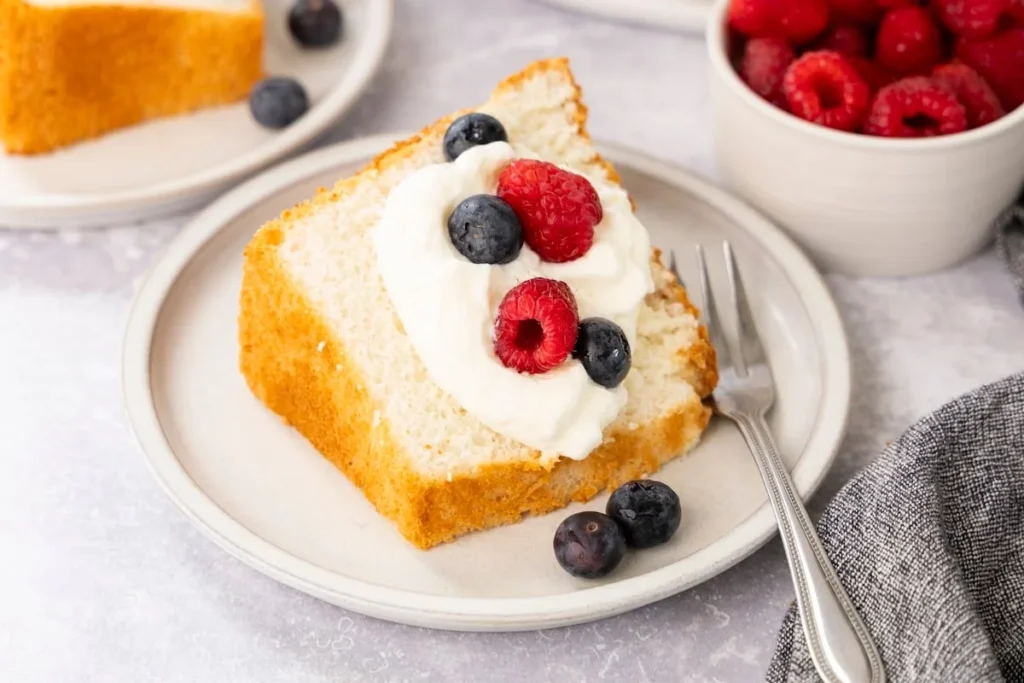
I keep a running list of desserts that are scared off by their own reputation. Angel food cake is number one on it. People read that it’s delicate, that you have to cool it upside down, that the egg whites can ruin everything. Then they never actually try it.
I’ve been through this with readers before, and I’ve been there myself: I made this cake the first time with a hand mixer, a tube pan that had been sitting in my cupboard for years, and a lot of second-guessing. It rose. It actually, genuinely rose. And the trickiest part was the knife, not the whisking.
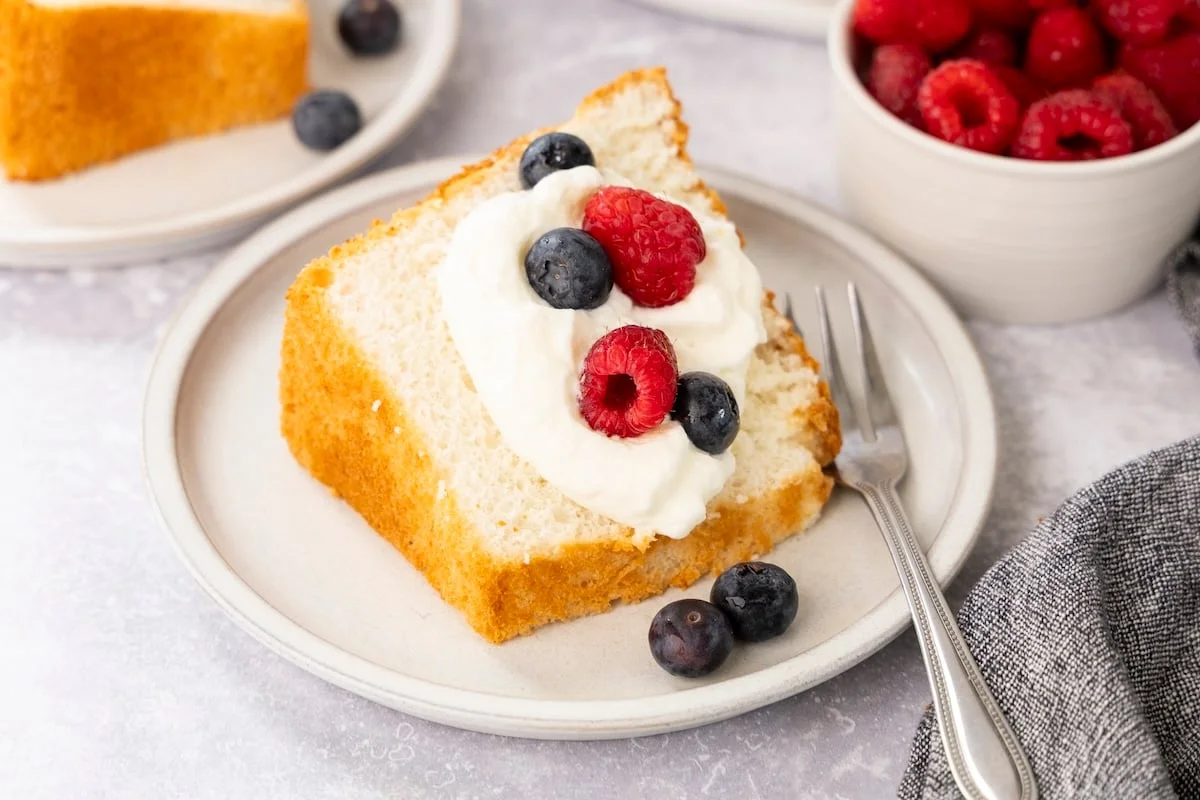
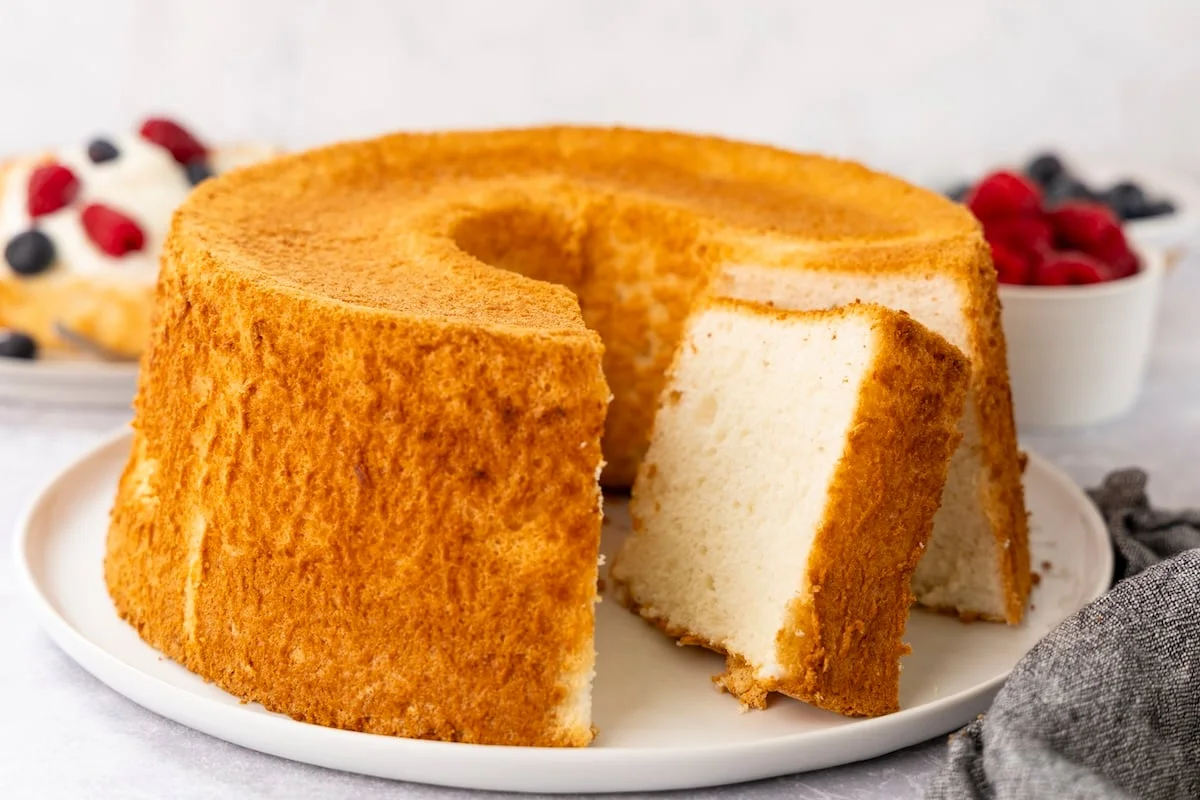
This is the cake that’s been an American favorite since the late 1800s. It became popular right around the time the hand-cranked eggbeater was invented, which made whipping the dozen or more egg whites far less painful. The name comes from how light the crumb is, supposedly fit for angels, especially next to the rich butter cakes of the day. It’s tall, feather-light, with a delicate vanilla-almond flavor and a lightly crisp golden crust. Serve it with fresh fruit and whipped cream, with lemon curd, or with nothing but a dusting of confectioners’ sugar.
Why this cake works
Here’s the honest version of the method. There are really only a few moves that matter, and none of them require special equipment beyond a whisk, a tube pan, and a little patience.
✓ Whip the egg whites properly, then stop. Sugar is added slowly, gradually, and you stop the moment the whites hold soft peaks with a gentle curl at the tip. Overbeaten whites turn dry and grainy and don’t expand as well in the oven.
✓ Don’t grease the pan. The batter needs to cling to the sides of the tube pan as it rises. An ungreased pan gives it the traction it needs to reach its full height.
✓ Cool it upside down. This is the secret to keeping it from collapsing under its own weight. Without this step, a beautiful rise turns into a dense disc.
Those three are the whole game. Everything else in the recipe below is just doing them carefully.
Ingredients
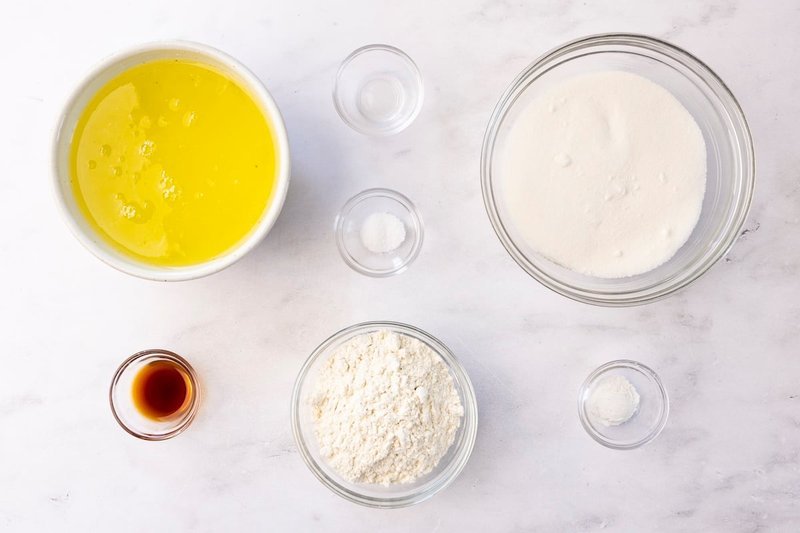
You’ll need a small bowl, a stand mixer with a whisk (or a handheld mixer and a large bowl), a sifter or fine sieve, and a 9-inch (23-cm) tube pan with a 16-cup capacity, preferably with a removable bottom. If yours doesn’t have a removable bottom, line the base with parchment paper, but don’t grease it.
- 1 cup cake flour (bleached, for the best rise)
- 1½ cups sugar, divided
- 12 large egg whites (fresh, not from the carton)
- 1 teaspoon cream of tartar
- ½ teaspoon salt
- 1½ teaspoons vanilla extract
- ½ teaspoon almond extract
5 simple steps
1. Mix the dry ingredients first. Preheat the oven to 325°F (165°C) and set the rack in the lower-middle position. In a small bowl, whisk together the flour and ¾ cup (150 g) of the sugar until evenly combined. Whisking them before you start means you won’t be rushing to fold later without overmixing.
2. Whip the egg whites with sugar. In the mixer bowl, beat the egg whites on medium-low (speed 4) until they’re broken up and foamy, about 1 minute. Add the cream of tartar and salt, raise the speed to medium (6), and beat until the whites are opaque and form very soft billowy mounds, about 2 minutes more. With the mixer still running, add the remaining ¾ cup (150 g) sugar, about 1 tablespoon at a time, over about 1 minute. Then beat until the whites are glossy and hold soft peaks, 2 to 3 minutes. When you lift the whisk, the peaks should curl gently over at the tip. If they look dry or grainy, you’ve gone too far.
3. Fold in the flavors, then the flour. Add the vanilla and almond extracts and beat just until blended, about 10 seconds. Then sift the flour mixture over the egg whites, a few tablespoons at a time, folding gently after each addition with a large rubber spatula. Broad, light strokes, sweeping down to the bottom of the bowl and lifting the batter up and over itself. Take your time here. If some flour falls onto the counter, just sift it back over the batter. The goal is to get all the flour in without deflating the whites.
4. Fill the pan and bake. Scrape the batter into the ungreased tube pan and smooth the top. Run a paper towel or your finger lightly around the top inside edge to wipe away any smears or drips. Tap the pan two or three times on the counter to release any large air bubbles. Bake for 45 to 55 minutes, until the cake is deeply golden and springs back lightly when pressed in the center.
5. Invert, cool, unmold. The moment the cake comes out of the oven, invert the pan to cool. If the pan has little feet, set it upside down on them. Otherwise, invert it over the neck of a bottle or a funnel so air can circulate underneath. Let it cool completely, 2 to 3 hours. Then turn it right-side-up and run a thin knife around both the outer edge and the center tube to loosen it. Remove the outer ring, then release the bottom, or peel off the parchment if you used it.
Serve on a platter, bottom side up. Slice with a serrated knife and a gentle sawing motion, so the delicate crumb doesn’t compress. This cake is at its best the day it’s baked, so plan for that.
Make it your own
A few notes from my own bakes, so you don’t have to learn them the hard way.
On flour: bleached cake flour (Swans Down, Softasilk) gives the lightest texture. Unbleached cake flour will work, but the cake may not rise quite as high or bake up as tender.
On eggs: use fresh egg whites, not the carton kind. Cartoned whites don’t whip up as well, so the cake can fall short on both height and that airy texture.
On the almond extract: it should never be obvious. It just adds a little depth under the vanilla. If your extract is strong, start with a bit less than the full ½ teaspoon.
On serving: fresh berries, a few spoons of whipped cream, or lemon curd all do this cake justice. It’s also lovely with just a little confectioners’ sugar and nothing else.
Start today
Three small things you can do before your next bake:
- Check that your tube pan is ungreased and, if needed, ready its removable bottom or a piece of parchment.
- Reserve 12 fresh eggs and set aside the whites. Skip the carton this time.
- Put a 30-minute timer on for prep. Prep is 30 minutes, cook is about 50, so total is 1 hour 20 minutes plus a few hours to cool. Knowing that up front keeps the evening calm.
A note from Elena: I’ve had this cake come out of the oven looking exactly like it’s supposed to, and I’ve had a batch that fell a little flat because I overwhipped the whites. Both were still worth eating, and both taught me the same thing: the technique matters more than the ingredients, and the ingredients are simple. You don’t need to be a great baker. You just need to stop at soft peaks.
Today’s tiny step: tonight, find your tube pan, wipe out the crumbs, and leave it ungreased where you’ll see it. That’s the whole first move. The cake will wait for you until the weekend.
— E, your habit neighbor